Bring in a document.
Keep the document on the canvas and reuse it.
Connect text, images, audio and video into your own AI workflow.
Open-source core · Your models · Self-hostable
Keep the document on the canvas and reuse it.
Extract the text for the next step.
Turn the same text into a summary and speech.
Combine the audio and a character image into a talking video.
Change the model without rebuilding the workflow.
Why TongFlow starts with modalities →Capability examples. Running requires compatible plugins.
Operations
Start with text, a file or a link.
Turn an image into text, video or another image.
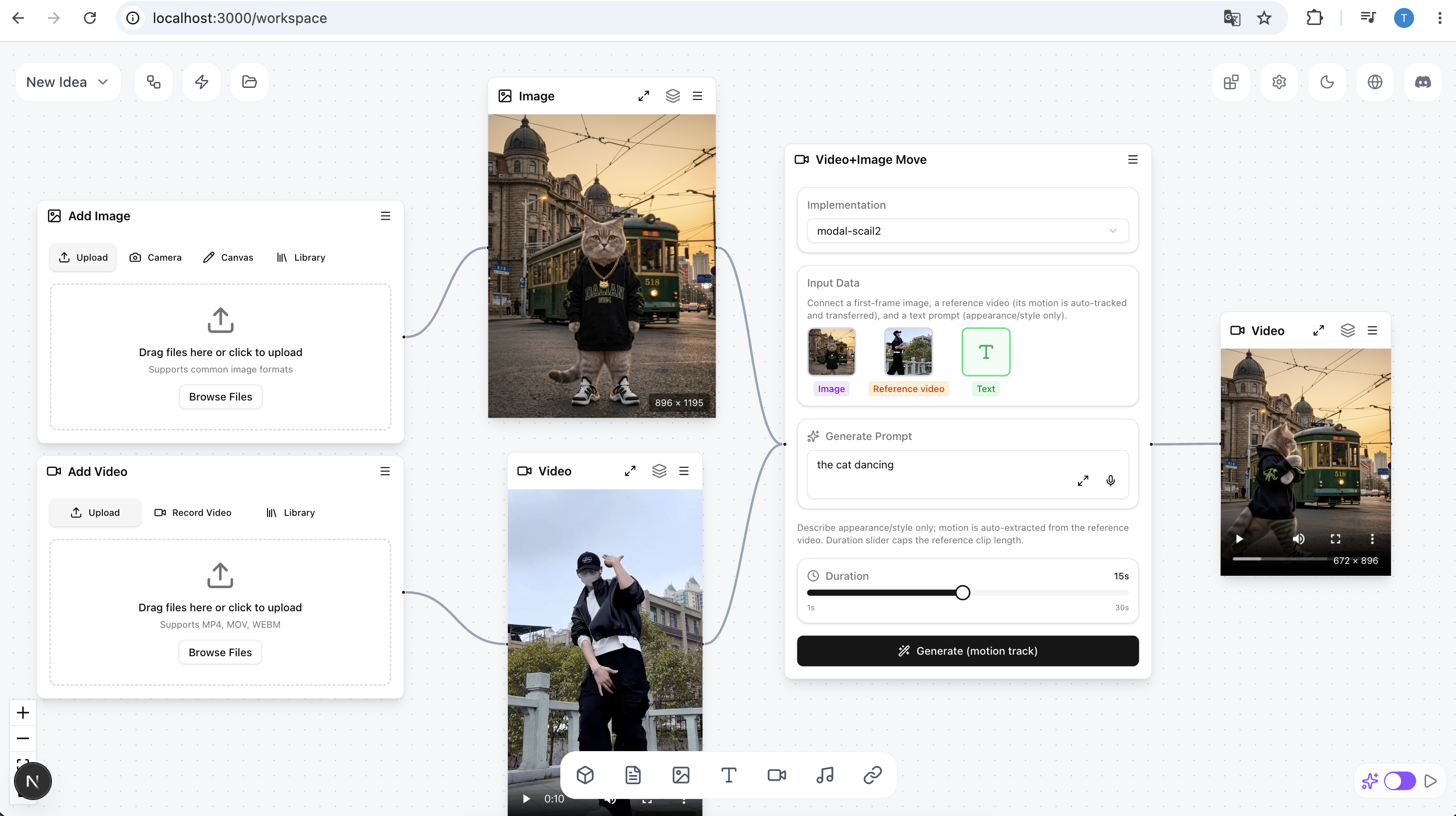
Combine an image and a voice into video.
Split into parts and process each one.
MODALITY-FIRST
Connect uploaded and generated materials to the next step.
Switch compatible models while keeping your workflow.
Build on the canvas or let an agent create an editable workflow.
Combine both inputs with a compatible motion-transfer plugin.
One open-source core. Connect the plugins and providers you need.
Connect your API keys or Modal account to run.
Open the workspaceConfigure plugins and models on your own infrastructure.
Get the sourceBuild with TongFlow or DSH; edit on the canvas.
Explore the DSH pluginTongFlow is an open-source tool for building multimodal AI workflows. Connect text, images, audio, video, 3D and documents on a visual canvas to extract, transform, generate or combine information. Each step runs through a compatible plugin and its model or processing implementation. You can use the cloud workspace or self-host the app.
You build around forms of information, such as text, images or sound. Capabilities connect those forms; models implement the capabilities. This gives different workflows a common structure.
Connections follow the input and output types of each capability. A workflow also needs compatible plugins. The design is open-ended, but available operations determine what can run today.
No. Understanding an image, extracting text, transcribing speech, splitting a video and combining materials are also part of the system. Generation is one kind of operation.
Use the cloud workspace or self-host the app, then configure the provider credentials required by your chosen plugins. Modal-backed plugins require a Modal account; API plugins require the relevant provider keys.
Cloud access is a subscription. Model API usage and GPU compute are billed separately by your providers. TongFlow does not sell generation credits. See pricing for the current subscription and trial details.
We use a single Google Analytics cookie to count page visits. No ads, no third-party tracking. Decline and nothing is set; accept once and you can change your mind anytime via "Cookie preferences" in the footer. Privacy policy